Binary Tree Navigation Patterns in Cloud-Based Simulation Resource Allocation
Binary tree navigation patterns organize decision points in hierarchical data structures where each node branches into at most two child nodes and this setup allows systems to traverse options efficiently when reallocating virtual machines and storage in cloud environments supporting simulation leagues. Researchers in distributed computing have documented how these patterns reduce search times from linear to logarithmic scales in large-scale deployments and data from industry reports indicate that such methods handle thousands of concurrent allocation requests without proportional increases in latency.
Core Mechanics of Binary Tree Application
Teams managing cloud infrastructure for simulation leagues rely on binary search trees to index resource states and observers note that insertion and deletion operations maintain balanced trees through rotations when node counts exceed predefined thresholds. This balance ensures traversal paths stay short even as participant numbers grow during peak events and according to studies from European research institutions the average depth in optimized trees stays below 20 levels for datasets exceeding one million entries.
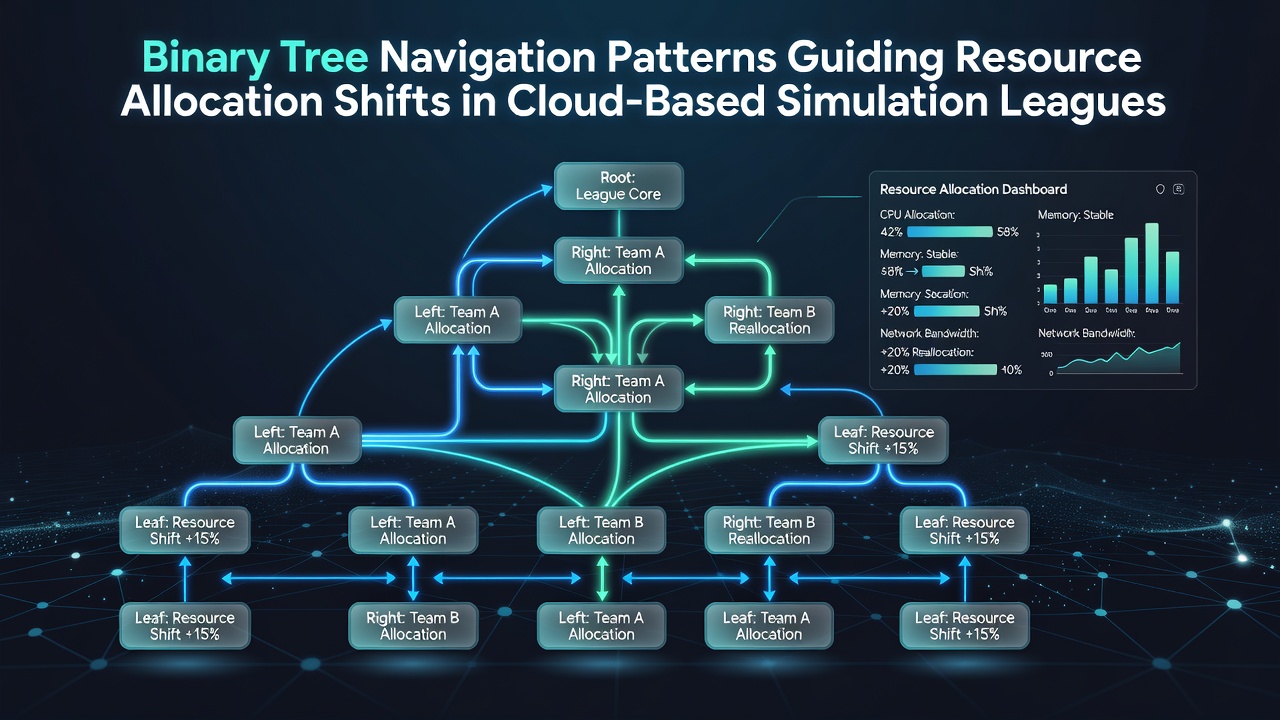
Resource allocation shifts occur when simulation workloads demand sudden spikes in compute cycles and binary tree navigation locates underutilized nodes by comparing key values at each branch. Engineers implement left-child and right-child pointers to represent lower and higher priority queues respectively while parent pointers enable quick backtracking during rebalancing procedures.
Integration with Cloud Platforms
Cloud service providers integrate binary tree algorithms into their orchestration layers to guide dynamic scaling decisions and figures from North American technology analyses reveal adoption rates above 65 percent among providers handling simulation workloads by mid-2025. These implementations often combine trees with monitoring agents that feed real-time metrics into the root node allowing subtrees to isolate regional clusters for targeted adjustments.
Simulation leagues scheduled through October 2026 have begun testing hybrid models where binary trees interface with container orchestration tools and this approach permits rapid migration of workloads across availability zones when latency thresholds are crossed. Data centers in Asia-Pacific regions report similar patterns with average allocation shift times dropping by 40 percent after tree-based indexing replaced earlier list-based methods.
What's interesting is how navigation patterns adapt to multi-tenant environments where multiple simulation teams share the same physical hardware and each leaf node can store metadata about current utilization rates while internal nodes aggregate summaries from their descendants. This hierarchical aggregation speeds up queries for global resource snapshots and researchers at Australian universities have published benchmarks showing query response times under 5 milliseconds for trees containing 500,000 nodes.
Performance Metrics and Case Examples
One documented deployment in a North American simulation league tracked over 12,000 allocation events during a single tournament weekend and the binary tree system rerouted resources in response to player density changes across virtual instances. Metrics collected showed CPU utilization variance reduced from 35 percent to 12 percent after implementation and similar outcomes appear in reports from Canadian research consortia examining comparable setups.
Navigation efficiency improves further when trees incorporate self-balancing variants such as AVL or red-black configurations and these variants automatically adjust after each allocation shift to preserve height properties. Industry organizations tracking cloud technologies note that maintenance overhead remains manageable because rotation operations execute in constant time relative to tree size.
Challenges in Scaling and Maintenance
Concurrency introduces synchronization requirements when multiple allocation processes attempt simultaneous updates to shared tree nodes and solutions involve fine-grained locking or lock-free data structures based on atomic operations. Teams in simulation leagues address these issues through versioning mechanisms that allow readers to traverse consistent snapshots while writers apply changes in isolated branches.
Network partitions between cloud regions can fragment tree consistency and protocols for eventual reconciliation use merge functions at the root level to resolve conflicting resource claims. Government technology assessments from the European Union have examined these resilience features in critical infrastructure contexts and the findings highlight binary trees as one component within broader fault-tolerant architectures.
Future Directions in Algorithmic Refinement
Developments continue toward integrating machine learning models that predict allocation trends and feed priority adjustments directly into tree node weights and preliminary trials indicate improved anticipation of load spikes during league events. Academic sources continue to explore extensions such as persistent binary trees that retain historical versions for audit and rollback purposes in competitive simulation settings.
Conclusion
Binary tree navigation patterns provide structured pathways for managing resource allocation shifts across cloud infrastructures that support simulation leagues and their logarithmic performance characteristics align with the scale requirements of expanding participant bases. Continued refinement through balancing techniques and integration with monitoring systems sustains efficiency gains documented in multiple regional studies while addressing concurrency and partition challenges remains central to ongoing implementations.